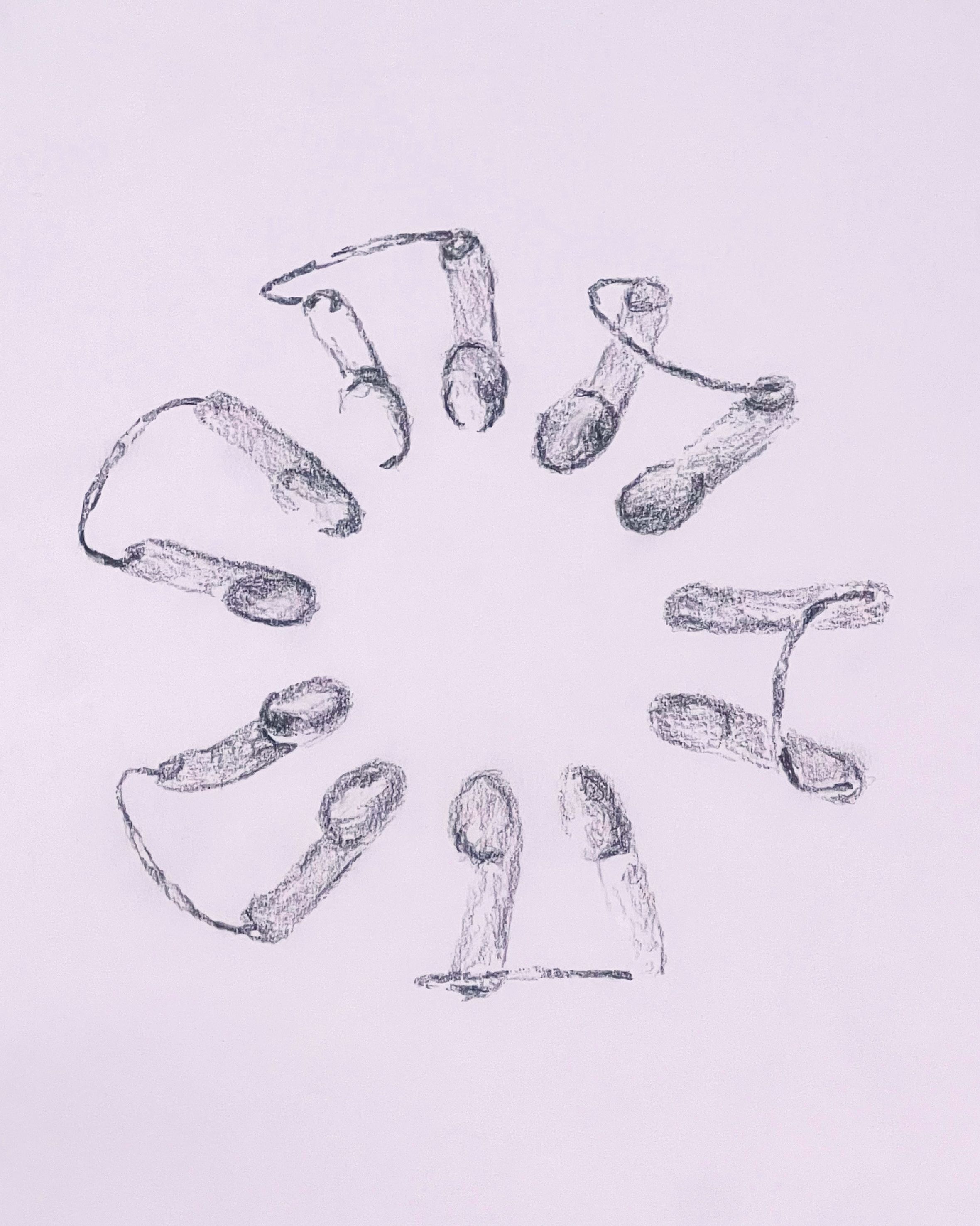
Human ambition to defy time and live forever is well known to everyone. For this reason, ceasing to breathe, even for just a few minutes, is at once a taboo, a challenge, and an achievement. The exhibition — Candela Capitán's first in Mexico, and also the first in which the artist, a choreographer but also a visual artist, fully enters the territory of installation — is titled Apnea. It is an installation activated by bodies that transforms the gallery space into a kind of "spa of the near future." With a complex, though visually simple, system of pipes, Candela turns the spaces into a circuit designed to feed a particular fountain/pool. Fountain, because water springs from that central element; and pool, because at certain moments it serves as a place to train in the difficult art of holding one's breath.
At a moment marked by a renewed interest in the Odyssey and the figure of Ulysses, it is worth remembering that one of the oldest and most reliable written traces of the practice of apnea already appears in Homer, around 750 BC. Later, around 480 BC, Herodotus describes a certain Scyllias of Scione as the best diver of his time, someone capable of recovering objects and treasures from shipwrecks for his buyers, Persian merchants.
In recent decades, many artists have turned their attention to the Haenyeo, the female tradition of divers on Jeju Island, Korea. Women who can descend around ten meters, remain underwater for approximately a minute on each dive, and work for hours alternating between diving and recovery. Upon surfacing they make a characteristic breathing sound, the sumbisori. This sound represents the fact that breathing here is not simply a physiological need, but becomes practically the sonic punctuation of the work. Imagine this sound in your head. Imagining oxygen entering the lungs again allows us to imagine its gradual absence. In reality, apnea is a technique that trains the body to manage that absence. It is not about doing without oxygen, but about extending the time during which the body can function without inhaling it again. Candela Capitán describes the installation-structure developed to practice apnea in the gallery as a "spa of the near future." Hearing her definition surprised me. Seen from the ignorance of those of us who, like me, cannot afford to stop breathing for even a few extra seconds without falling into dark panic, apnea seems like the furthest thing from a spa and the closest thing to caressing its opposite: anxiety in its purest state. To understand her words we need to understand that the training does not eliminate the need to breathe, but is aimed at radically changing one's relationship to the alarm the body produces in response to that need. It is about learning to remain a little longer inside that alarm. To recognize the moment when the body starts asking for air, to listen to how that request grows and, instead of responding immediately, to stay calm. Little by little, the body discovers that urgency is not yet the limit. It learns not to rush, to spend less, to move less, to trust its reserves. Apnea does not silence the alarm: it teaches us to inhabit it. At a moment marked by anxiety, panic, and shutdown as constants of our physical response to social, political, and economic conditions that overwhelm us and reveal how alone we feel in the face of our circumstances, I consider Candela Capitán's proposal to be wonderful. It is wonderful because it places all its force and emphasis on understanding what the alarm is, and it proposes a different way of studying it, of relating to it, and even of using it for our own pleasure.
Apnea comes across to me as a social sculpture, almost in historical terms: a piece capable of awakening in us a pedagogical sense aimed at understanding our relationship with alarm and the need to train ourselves to live it differently. Anxiety has the particular capacity to turn a signal into a threat, and that threat into a new signal. The body becomes alarmed, and we become alarmed that the body has become alarmed. Apnea proposes a strange exercise in the opposite direction. It deliberately produces one of the most elemental alarms we possess — the need to breathe — and teaches us to learn that between the appearance of an alarm and our reaction to it there exists a small space. Learning to remain in that space is one of the most radical forms of calm that exists. On the other hand, the performance, carried out once a week by beings who have already reached that place and dressed in a suit designed for the occasion by Candela, exposes us to the dramaturgy and choreographic passion of this artist's work, but from a different place. The body that does not breathe underwater is also a body that dances in the water, adding a fantastical dimension to that figure floating between the natural and the supernatural. I cannot stop thinking of Ophelia, the young woman in love with Hamlet who, after her father's death at Hamlet's hands and consumed by madness, ends up drowning, and of all the Ophelias who came after her: drowned women, deaths portrayed with unprecedented beauty following a violent death. By contrast, Candela Capitán's women divers survive. They have learned to control the circumstances and offer us the great reverse of female death and the best possible news: its absence. Those women underwater not only do not die: they resurface. And not only do they resurface: they reign.
The piece also points toward a fundamental paradox of contemporary capitalism: its need to keep us exhausted. A system driven by permanent productivity pushes our bodies again and again to their limits, only to later discover in those very limits a new market. Our exhaustion thus becomes productive twice over: first, through the energy extracted from us, and then, through everything we are willing to consume in order to recover. Wellness, in this sense, is not simply a response to fatigue, but part of the economy that fatigue itself has made possible. Perhaps this is why recovery has become such a powerful contemporary desire. We dream of sleeping, of silence, of breathing better, of slowing down, of escaping anxiety, as if these most elemental bodily capacities had become difficult to attain without help. Apnea introduces a strange twist into this logic: instead of promising the elimination of discomfort, it asks what happens when we learn to enter into it, to remain there, and to discover that our limits may not be exactly where we've been told they are.
Chus Martínez.